Dense coating with a secure interface
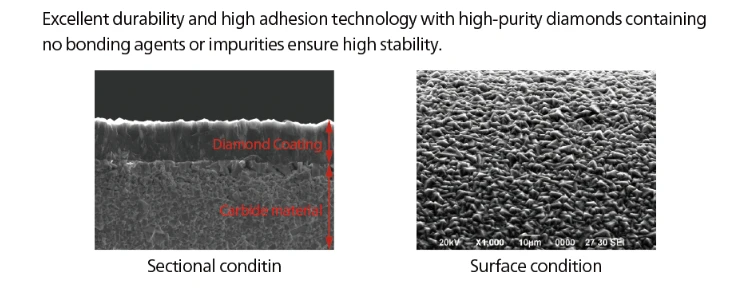
Substrate chemistry and microstructure promote diamond nucleation, reducing the risk of premature coating separation on the 4DBE series during abrasive cutting.
4DBE · Product family
Diamond coating · individual inspection · dimensional report available
4 Flute Diamond Coated Ball End Mills for Graphite currently shows Ø1–12 mm across 55 standard order codes. It combines a fine-grain carbide substrate selected for diamond-deposition compatibility with a ball-nose cutting profile for 3D electrode contours, curved surfaces, ribs, and mould details. The standard-reach form keeps projection compact for rigid, repeatable production machining. Four flutes provide stable tooth engagement for finishing passes and controlled side milling.
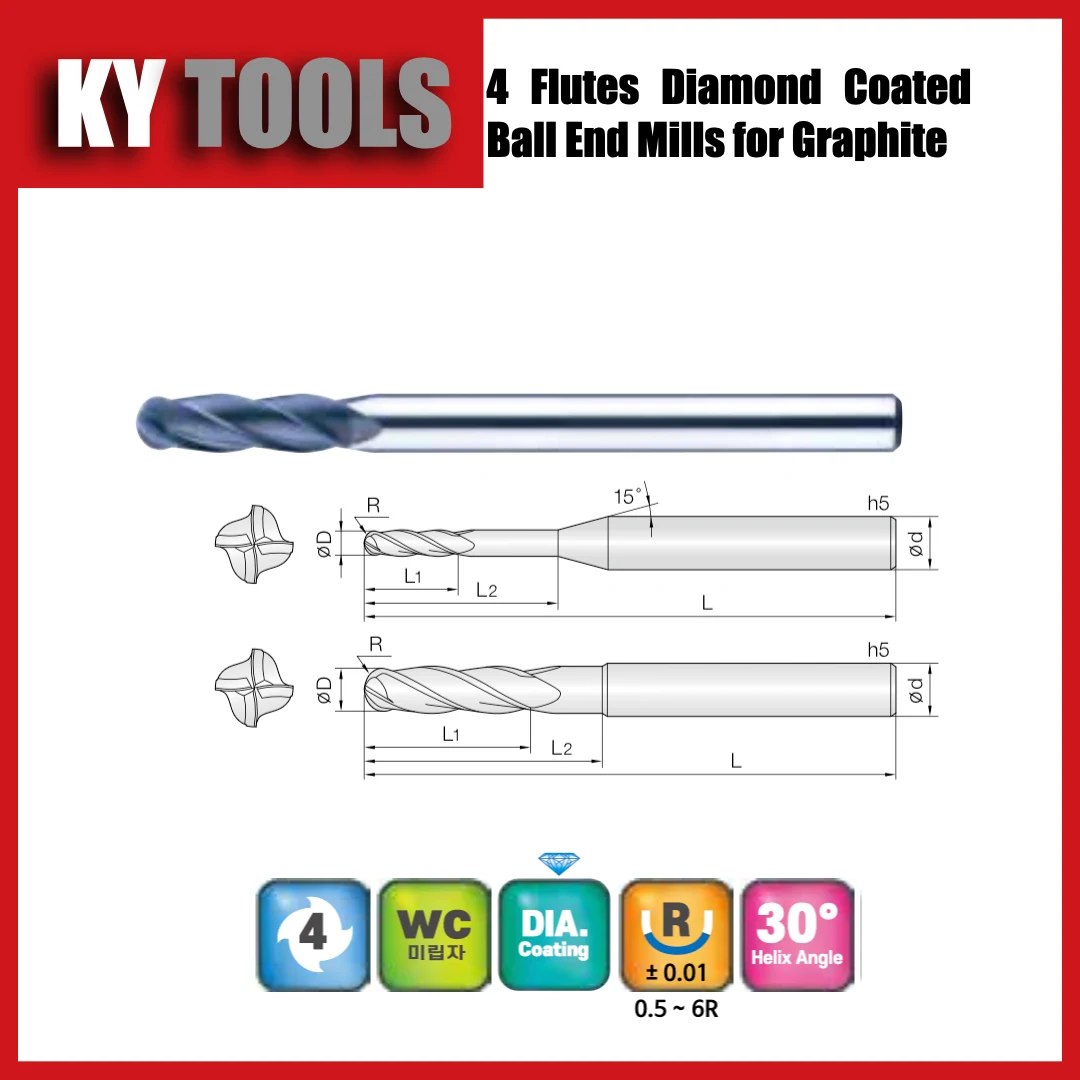
Standard series specifications
Select the end geometry, flute count, and reach style for the required profile, cutting depth, and chip evacuation. The size and price table below lists every standard order code, key dimension, and USD/pc reference price for engineering selection and purchasing.
4DBE coating and edge-retention evidence
Keeping the spherical cutting edge sharp helps control cusp height and surface consistency as the tool follows changing contact points. The standard-reach form keeps projection compact for rigid, repeatable production machining.
Substrate chemistry and microstructure promote diamond nucleation, reducing the risk of premature coating separation on the 4DBE series during abrasive cutting.
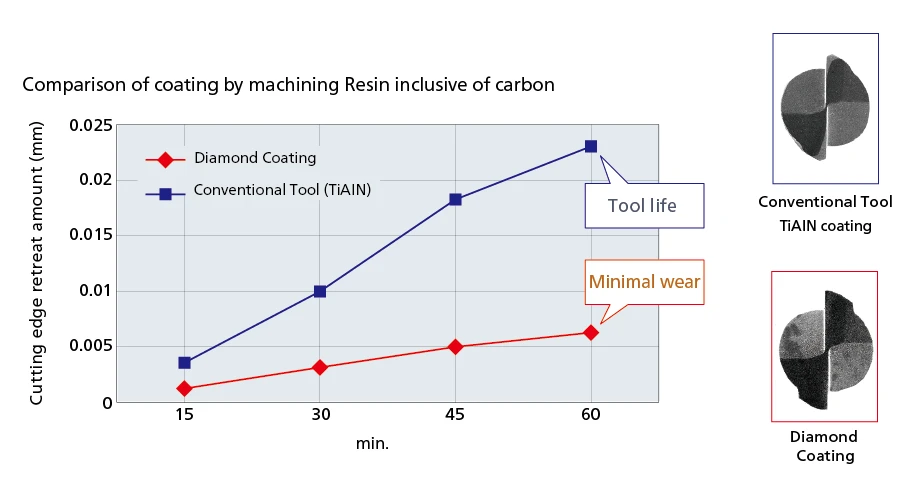
The shown carbon-resin test records about 0.006 mm edge retreat for diamond coating versus 0.023 mm for TiAlN. For this ball-nose cutting profile for 3D electrode contours, curved surfaces, ribs, and mould details, lower wear supports more consistent profile retention.
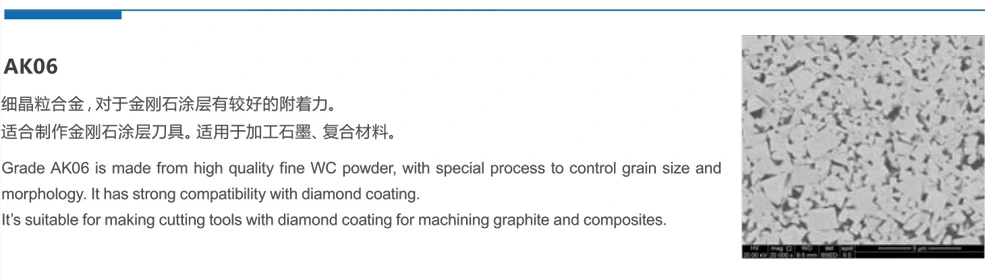
AK06 uses high-quality fine WC powder with controlled grain size and morphology, providing a diamond-compatible substrate for this 4-flute ball nose graphite end mill family.
Detailed codes, dimensions & reference prices
55 standard order codes with transparent online USD/pc FOB China prices updated 2026-Sep-14. Standard terms are 100% T/T in advance with a reference lead time of 10–15 working days. Final price and delivery are confirmed against quantity, dimensions, tolerance, and coating requirements.
Starting parameters for graphite
Choose cutter diameter, then select the applicable reach or taper combination to view spindle speed, feed rate, axial depth ap, and radial width ae. Use the result as a test-cut starting point and optimise for machine rigidity, actual overhang, runout, and graphite grade.
Select cutting condition
Use the selection to establish first-piece test-cut settings; final values depend on the machine and setup.
Selected reference
Spindle speed
16,000
rev/min
Feed rate
700
mm/min
Axial depth ap
0.2
mm
Radial width ae
0.2
mm
| Diameter D | RPM | Feed | ap | ae | Vc | fz |
|---|---|---|---|---|---|---|
| mm | rev/min | mm/min | mm | mm | m/min | mm/tooth |
| Ø1 | 16,000 | 700 | 0.2 | 0.2 | 50.3 | 0.0109 |
High-feed finishing and smooth 3D surfaces in rigid CNC setups.
Extreme hardness also means brittleness. Use a rigid CNC, precision holder, and secure workholding; control runout especially on long-reach and small-diameter tools, and avoid impact entry.
4DBE dimensional verification
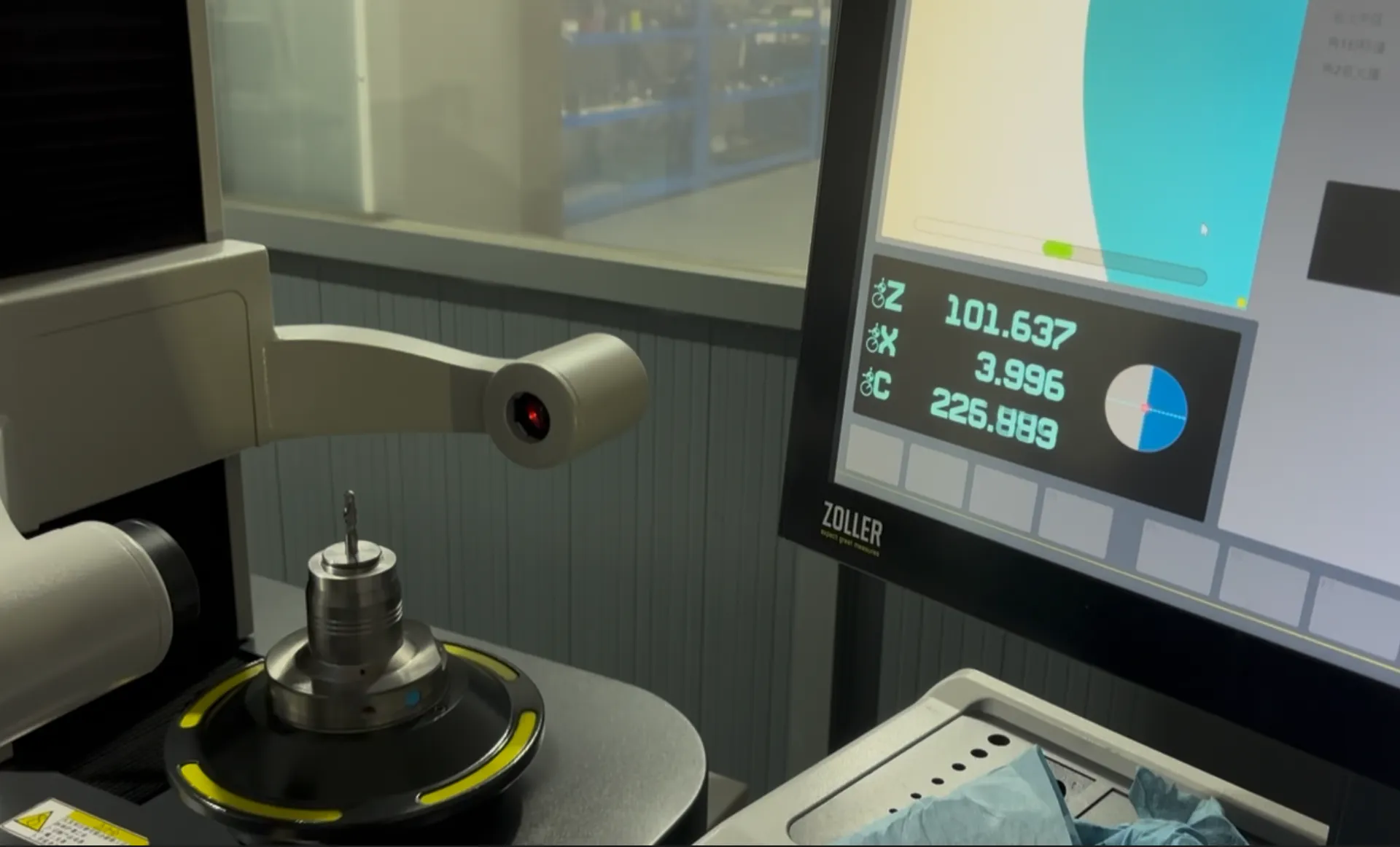
Ball-profile radius, cutter diameter, runout, and the transition into the flute are checked for predictable 3D finishing. A dimensional report can be supplied with the order for acceptance and traceability.
Ball nose abrasive-material machining
The 4DBE series uses a ball-nose cutting profile for 3D electrode contours, curved surfaces, ribs, and mould details. Its diamond-coated carbide edge is designed for graphite electrodes and, after application validation, abrasive non-metals such as CFRP and GFRP.
For abrasive composite profiling, the rounded end supports contour following; confirm laminate support and entry strategy to control delamination.
Related graphite tooling